Institutional Insights: Nomura - Multi Asset Take

Ceasefire Relief Rally vs. Unresolved Medium-Term Risk
The key market message is that several things can be true at once. A ceasefire headline can drive a powerful near-term risk rally, particularly through positioning and volatility mechanics, while the broader geopolitical and macro backdrop remains fragile. In our view, the latest move should be understood less as a durable resolution and more as a tactical pause that creates time, reduces immediate tail risk, and preserves future policy optionality.
Geopolitical interpretation
Our read is that the current ceasefire should not be treated as a definitive end-state. Rather, it appears more consistent with a temporary de-escalation following a period in which the risk of a broader regional and market accident had risen materially. That matters because a tactical pause can ease immediate pressure without resolving the core strategic disputes.
Several points remain important:
The arrangement appears better understood as a buying-time exercise than as a durable settlement.
US force posture and regional military positioning suggest that future optionality is being preserved, not surrendered.
The market is unlikely to assume lasting stability while key issues remain unresolved, especially around nuclear constraints, maritime transit, and enforcement credibility.
Ongoing flare-ups would not be inconsistent with this framework, particularly given the risk of decentralized action by affiliated groups.
In that sense, the ceasefire reduces near-term disaster risk, but it does not eliminate the possibility that markets revisit these same stress points over the coming weeks.
Energy and real-economy implications
Even if hostilities pause, the supply shock to energy and petrochemicals does not simply reverse on headline improvement. Physical markets operate with lag, and the disruption already introduced into logistics, freight, inventory management, and insurance can continue to affect pricing well beyond the initial event window.
The practical implications are straightforward:
Tanker dislocation and route disruption take time to normalize.
Inventory drawdowns cannot be replenished immediately.
War-risk insurance premia and related shipping frictions often remain elevated after the initial shock.
Force majeure and contract disruption can continue to impair flows even after a formal pause.
Physical differentials may remain stressed despite lower headline geopolitical anxiety.
From a macro perspective, this means that while financial markets may celebrate a de-escalation, the real economy may still face a period of elevated energy-related friction. In other words, some of the damage is already embedded.
Market mechanics and the equity response
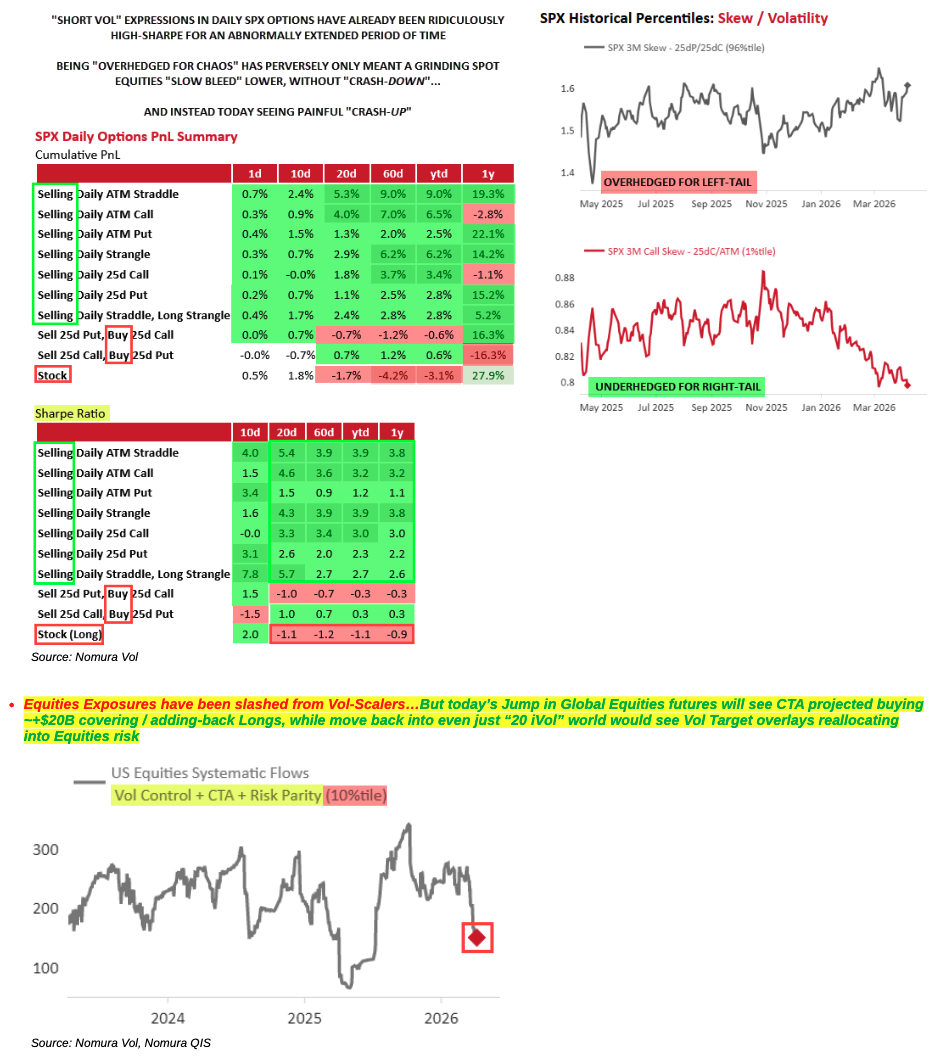
The sharp equity response can be understood through market structure as much as through fundamentals. A sudden reduction in perceived tail risk tends to trigger an equally sudden adjustment in volatility markets, and that creates mechanically supportive conditions for spot equities.
The likely channels include:
Put destruction, which reduces dealers’ need to remain defensively hedged.
Skew flattening, as demand for downside protection eases.
Vol-of-vol compression, which reinforces the decline in implied volatility.
Positive vanna/volga effects, which can create incremental spot support as options books reprice.
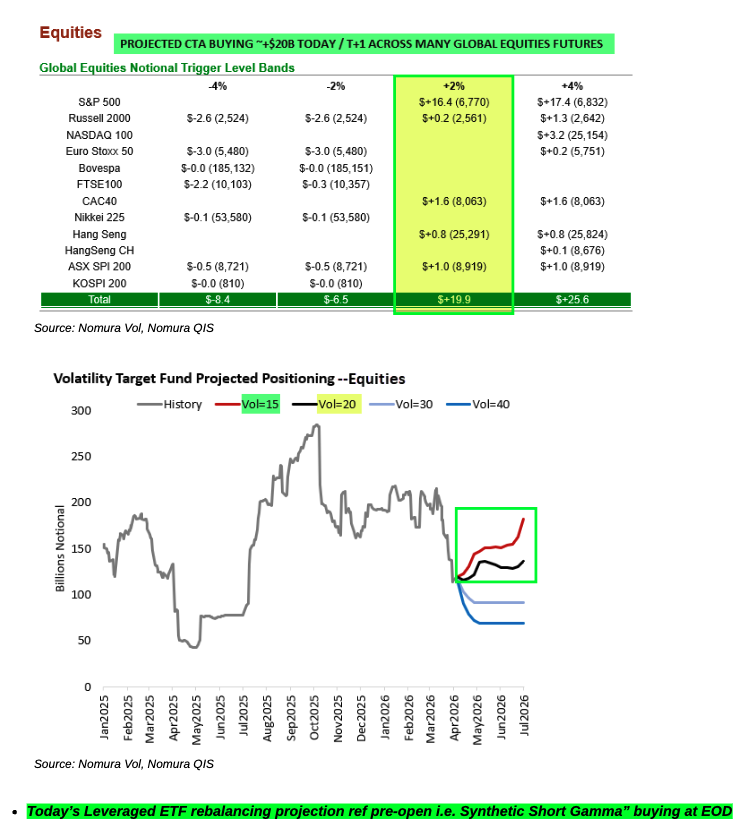
Systematic re-risking, as vol-sensitive strategies rebuild exposure after earlier deleveraging.
This dynamic can be especially painful for underinvested investors, macro bears, and over-hedged portfolios. A rally driven by collapsing volatility is often self-reinforcing in the near term, particularly when funds have already reduced gross and net exposure and are then forced to chase a market moving sharply higher.
That helps explain why the rally can be large even if conviction on the underlying ceasefire is limited.
What the market still needs to learn
While the immediate reaction is understandable, we do not think the market has full clarity on the issues that will determine whether this move has durability. The focus now shifts from the headline itself to the substance behind it.
Key areas to watch include:
Issue | Why it matters | Market relevance |
|---|---|---|
Uranium / nuclear terms | Determines whether the ceasefire has strategic depth | Affects geopolitical risk premium |
Strait transit and shipping terms | Critical for energy and tanker flows | Drives crude, freight, and insurance pricing |
Enforcement credibility | Tests whether the pause can hold | Determines persistence of relief rally |
Proxy activity / flare-ups | Indicates how decentralized the conflict remains | Sustains event risk and volatility |
US military posture | Signals whether this is true de-escalation or paused escalation | Shapes medium-term risk appetite |
The central point is that the market has received a reduction in immediate uncertainty, not a comprehensive resolution of the underlying conflict.
Investment takeaway
Our interpretation is that the market is correctly responding to a near-term removal of catastrophic downside, but may also be vulnerable to over-extrapolating that relief. The rally is real, and the positioning dynamics behind it are important. At the same time, unresolved geopolitical demands, ongoing energy-market friction, and the possibility of renewed escalation argue against treating the move as full-cycle clarity.
The cleanest way to frame it is as follows:
Near term: supportive for equities through vol compression, hedge unwind, and forced re-risking.
Medium term: still uncertain, with meaningful scope for renewed stress if the ceasefire proves tactical rather than durable.
Macro backdrop: improved at the margin on tail-risk removal, but not repaired in the underlying energy and supply-chain channels.
The key takeaway is that this can be a powerful relief rally without being a durable resolution. Markets may trade as though the danger has passed, while the underlying conditions suggest the issue has more likely been deferred than solved.
Disclaimer: The material provided is for information purposes only and should not be considered as investment advice. The views, information, or opinions expressed in the text belong solely to the author, and not to the author’s employer, organization, committee or other group or individual or company.
Past performance is not indicative of future results.
High Risk Warning: CFDs are complex instruments and come with a high risk of losing money rapidly due to leverage. 68% and 74% of retail investor accounts lose money when trading CFDs with Tickmill UK Ltd and Tickmill Europe Ltd respectively. You should consider whether you understand how CFDs work and whether you can afford to take the high risk of losing your money.
Futures and Options: Trading futures and options on margin carries a high degree of risk and may result in losses exceeding your initial investment. These products are not suitable for all investors. Ensure you fully understand the risks and take appropriate care to manage your risk.
Patrick has been involved in the financial markets for well over a decade as a self-educated professional trader and money manager. Flitting between the roles of market commentator, analyst and mentor, Patrick has improved the technical skills and psychological stance of literally hundreds of traders – coaching them to become savvy market operators!